AI Is Changing How Work Gets Done
But it can’t decide what that work should be about. That’s still the job of leaders who know their people. Our founder Brandon Miller recently returned from Gallup’s CliftonStrengths Forum in Omaha. He came home with big ideas on how AI and strengths can work together to help people spend more time doing what they do best.
Here’s his reflection on the experience and what it means for the leaders we serve. Read on below!
I came home from Omaha with a full notebook and one idea I haven’t stopped thinking about: What could happen if we helped people use AI to spend more of their week doing what they do best?
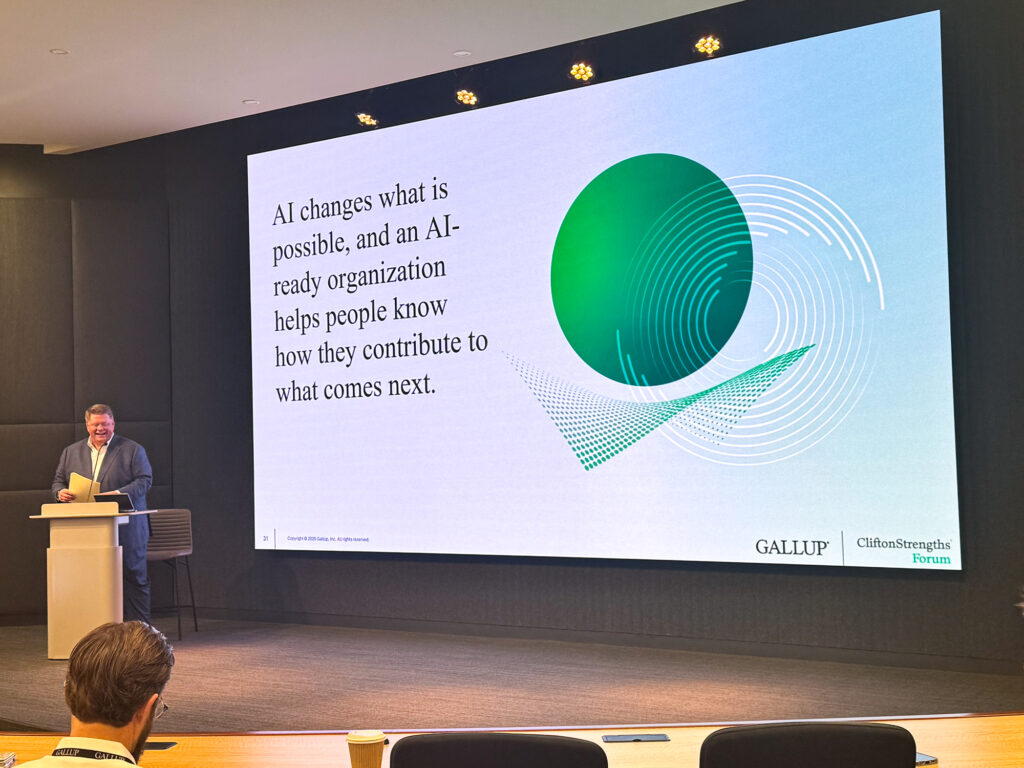
I had been invited to Gallup’s CliftonStrengths Forum, a gathering of coaches, practitioners, and leaders exploring strengths and the future of work. I was grateful for the invitation and the generosity of the team. From dinner to the coaches’ breakfast, I felt welcomed as a partner in the conversation. There was room to ask questions, reconnect with people, and think about what we could build together.
The presentations gave me plenty to consider. But during the session on the AI-ready organization, I started connecting what I was hearing to the work we do with leaders every day. In my notebook, I wrote: “Training on CliftonStrengths and AI. Develop a course.”
That is usually a good sign that my Activator has entered the conversation.
The idea that stayed with me was this:
Table of Contents
ToggleAI amplifies the culture it enters.
If people already work in an environment of fear, unclear expectations, and low trust, introducing AI can make those problems worse. People may wonder whether their jobs are being replaced, whether they can safely ask questions, or whether using a tool will get them in trouble.
If they work in a culture where managers listen, expectations are clear, and learning is encouraged, there is a much stronger foundation. People can explore how AI might help them contribute more. They can try something, talk about what worked, and get support when it didn’t.
We still have to do the human work of leadership. Buying a tool doesn’t create trust. Managers build trust through the way they treat people, especially when work is changing.
This is where I got excited about the connection to CliftonStrengths.
At 34 Strong, we help people look at their work through three areas: Grind, Greatness, and Genius.
Grind is the work you have to do, but it doesn’t draw on your best contribution. Greatness is work you’re really good at, although being good at it doesn’t always mean it gives you energy. Genius is where your strengths, enthusiasm, exceptional performance, and greatest contribution come together. It’s you at your best.
The challenge is that Grind and Greatness can fill the entire calendar. People rely on your competence, the work keeps coming, and your Genius gets whatever time is left.
Now imagine a manager who is excellent at developing people but spends hours each week organizing information and preparing routine updates. With an approved AI tool and appropriate review, some of that preparation could take less time. What if the manager invested those recovered hours in coaching conversations, helping a struggling employee, or developing someone ready for more responsibility?
That is a practical expression of what we call the Genius Advantage.
Know it. Protect it. Leverage it.
The value comes from deciding where that recovered time will go. If we simply fill it with more tasks, we may miss an opportunity to improve both the person’s experience and the team’s results.
Our strengths also give us different starting points for using AI. Someone who leads with Executing strengths might explore how it helps organize a process or prepare a project plan. Influencing strengths might find an opening in shaping a message or getting an idea moving. Relationship Building strengths might use it to prepare thoughtful questions for a conversation. Strategic Thinking strengths might explore alternatives or organize information before making a decision.
Those are possibilities to explore, not rules about people. At the forum, we also heard about concern across all four domains. We shouldn’t assume that someone’s strengths tell us how comfortable they are with AI. We need to ask them.
For leaders, especially the government managers we serve, I would start with two conversations.
- First, ask each person: “Where does your work get in the way of your best contribution?” Look at a real week together. Find one task where an approved use of AI could reduce friction. Be clear about the information that can be used, what requires human review, and who is accountable for the result. Public service depends on trust, so those boundaries matter.
- Second, ask: “If we gave you some time back, where could you make the greatest difference?” Then protect that time. Put the coaching conversation, the problem-solving session, or the service improvement on the calendar. Follow up to see whether the change actually helped.
That gives us a way to connect efficiency with engagement, well-being, and service to the people who depend on us. It also gives employees a voice in how their work evolves.
I left Omaha encouraged by the possibilities and grateful for the people doing this work alongside us. We’ll be exploring more of these ideas through my upcoming Gallup podcast appearance and conversations with the coaches joining Season 4 of Coach to Coach. I also see an opportunity to bring this directly into how we equip managers and teams.
For now, here’s the question I would leave with you:
If AI helped you reclaim five hours next week, what would you do with those hours that would bring out the very best in you?

Brandon Miller
Brandon Miller is the founder of 34 Strong, where he helps organizations, especially in the public sector, build strengths-based cultures that improve engagement, performance, and service. He is also the host of the Coach to Coach podcast, which brings together strengths coaches and practitioners from around the world.
Through his work with leaders and teams, Brandon focuses on turning strengths awareness into everyday action. That work is anchored in the Genius Advantage: know it, protect it, leverage it.
Be the First to Know
Join a community of growth-minded leaders receiving curated insights, free resources, and priority access to what’s next.